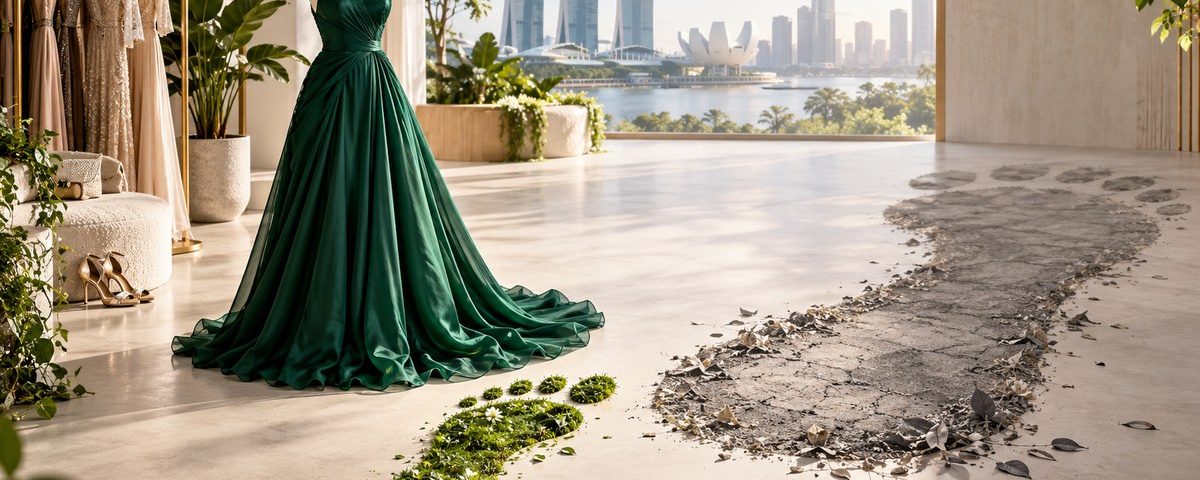
You already know the statistics. The fashion industry pumps out more carbon than international flights and shipping combined. Each new garment carries a hidden cost of water, energy, and emissions before it even reaches the hanger. But here is the good news. You do not have to give up looking amazing to make a difference. In fact, you can cut your fashion carbon footprint by up to 80% with one simple change. Renting clothes reduces carbon footprint in a way that feels effortless, especially when you have a wedding, gala, or corporate dinner coming up.
Renting a single gown instead of buying new can reduce your fashion carbon footprint by up to 80%. The savings come from avoiding manufacturing emissions, extending the life of existing garments, and keeping clothes out of landfills. For Singaporeans who attend multiple events each year, rental fashion is the most practical path to a lower impact.
The 80% Figure Is Real. Here Is How It Works.
When you buy a new dress, the carbon footprint starts long before you wear it. Fibres must be grown or synthesised. Fabric must be woven, dyed, and cut. The finished garment travels across oceans to reach a store in Singapore. Each step burns fuel and releases CO2.
A landmark study by the Ellen MacArthur Foundation found that extending the active life of a garment by just nine months reduces its carbon, water, and waste footprint by 20 to 30% per item. Renting takes that logic further. One rental dress can serve five, ten, or even twenty different women over its lifetime. The emissions from that single manufacturing run are divided among all those wears. Your share of the carbon cost becomes tiny.
Compare that to buying a dress you wear once to a friend’s wedding at the Grand Hyatt or a company dinner at Marina Bay Sands. That single wear carries the full manufacturing burden. Renting clothes reduces carbon footprint precisely because it spreads the environmental cost across many users.
What Makes Up a Garment’s Carbon Footprint?
To understand the 80% saving, you need to see where the emissions come from. Here is a breakdown of the typical lifecycle of a dress.
| Stage | Carbon Impact | What It Involves |
|---|---|---|
| Raw material production | 30% | Growing cotton, making polyester, or producing viscose |
| Textile manufacturing | 20% | Spinning, weaving, dyeing, finishing |
| Garment production | 15% | Cutting, sewing, assembling the final piece |
| Transport and retail | 10% | Shipping to warehouses, stores, and your home |
| Consumer use | 5% | Washing, drying, ironing over the dress’s life |
| End of life | 20% | Decomposition in landfill or incineration |
When you rent, you skip the first four stages entirely. The dress already exists. You only add the consumer use stage, and even that is minimal because professional rental services clean items in efficient bulk loads. The end of life impact is also delayed significantly because the dress stays in circulation longer.
How Renting One Gown Saves More Than You Think
Let us make this concrete. Imagine you have a black tie event at the Ritz Carlton this December. You find a stunning Oscar de la Renta gown online. The retail price is SGD 4,500. You wear it once, take photos, and hang it in your wardrobe. Chances are you will not wear it again. The dress sits there for years before eventually being donated or thrown away.
Now imagine you rent that same gown from StyleLease. You wear it for your event. You return it. The gown gets cleaned and inspected. Two weeks later, another woman wears it to a charity ball. Then another woman rents it for a gala dinner. Over two years, that single gown might be worn fifteen times. The carbon footprint of manufacturing that one dress is now shared across fifteen wearers. Your personal share is about 6% of the total manufacturing emissions.
That is where the 80% reduction comes from. You are not creating demand for a new garment. You are using one that already exists.
The Practical Steps to Renting Your Next Gown
If you are new to fashion rental, the process is simpler than you think. Here is a numbered list of steps to get you started.
-
Check your event dress code first. Is it black tie, cocktail, or semi formal? Knowing this narrows your search instantly. Read our guide on cocktail attire decoded for help with tricky dress codes.
-
Browse the collection by occasion, size, and designer. Use filters to find gowns that match your colour palette and silhouette preference.
-
Book your rental at least two weeks before your event. This gives you a buffer for sizing and any last minute changes. Our article on how far in advance to book a rental dress in Singapore has more timing tips.
-
Try on your dress when it arrives. Check the fit against your measurements. If something feels off, use our guide on how to make your rented dress fit like custom made.
-
Style it with accessories you already own. A belt, a pair of heels, or a clutch can transform the look. Learn how in shoes and bags the 80 20 rule for accessorising rental dresses.
-
Return the dress on time. The cleaning and inspection process is handled by the rental service, so you do not have to worry about stain removal or dry cleaning.
What about the Environmental Cost of Cleaning?
Some people worry that renting is not actually greener because of the cleaning required between rentals. This is a fair question. Let us look at the data.
Professional garment cleaning uses industrial machines that are far more efficient than home washing machines. They handle multiple items at once, use less water per garment, and employ eco friendly solvents. A 2020 study from the University of California found that the cleaning phase accounts for less than 3% of a rented garment’s total lifecycle emissions. Compare that to the 65% of emissions that come from manufacturing a new dress.
“Renting is not a perfect solution, but it is a dramatically better one. The carbon saved by avoiding new production far outweighs the small cost of professional cleaning.” – Dr. Li Wei, Sustainability Researcher at NUS
So yes, the cleaning adds a tiny amount of carbon. But the 80% reduction still holds because manufacturing is the elephant in the room.
Common Mistakes That Reduce Your Carbon Savings
Even with rental, you can accidentally increase your footprint if you are not careful. Here are the pitfalls to avoid.
-
Renting and then buying the same dress because you loved it. If you truly love a rental piece, check if you can rent it again for future events instead of buying. Our article on can you wear the same rental dress to two different weddings shows you how to restyle it.
-
Shipping the dress back individually without combining returns. Some rental services allow you to return multiple items together. Consolidate your returns to reduce transport emissions.
-
Using excessive accessories that you buy new just for one event. Instead, borrow accessories from friends or use what you already own. Our guide on the capsule accessories collection every dress renter needs helps you build a versatile kit.
-
Renting a dress that is not right for the climate. In Singapore’s humidity, a heavy satin gown might require extra air conditioning and more frequent cleaning. Opt for breathable fabrics like silk, chiffon, or cotton blends. Check how to stay cool and chic while wearing rental dresses in Singapore’s humidity for fabric recommendations.
Why This Matters for Singapore’s Event Season
Singapore’s social calendar is packed. You have Chinese New Year visits, wedding banquets, corporate galas, National Day celebrations, and the F1 Grand Prix. Each event typically calls for a new outfit. If you buy a new dress for each occasion, your annual fashion carbon footprint can be substantial.
Let us run the numbers. Suppose you attend five events in 2026. You buy five new dresses at an average of SGD 200 each. The total manufacturing carbon for those five dresses is roughly 300 kg of CO2. If you rent all five instead, your share drops to about 60 kg of CO2. That is a saving of 240 kg. To put that in perspective, that is equivalent to not driving a car for 600 kilometres.
A Simple Way to Multiply Your Impact
Renting clothes reduces carbon footprint on its own, but you can amplify the effect by making a few extra choices.
-
Choose rental pieces made from natural or recycled fibres. Our list of 5 eco friendly fabrics to look for when renting your next gown helps you identify lower impact materials.
-
Rent for your bridesmaids or wedding party. Coordinating outfits for a wedding can mean buying five or six new dresses. Renting them instead cuts the carbon footprint of the entire bridal party. See our guide on how to style your bridesmaids on a budget without compromising on elegance.
-
Combine rental with a capsule wardrobe approach. Instead of renting a different dress for each event, rent one versatile piece and style it differently. Learn how in how to style one rental dress three different ways for multiple events.
The Bigger Picture: Circular Fashion in Singapore
Renting is part of a larger shift toward circular fashion. Instead of the old model where clothes are made, used briefly, and thrown away, circular fashion keeps materials in use for as long as possible. When you rent, you participate in that cycle. You also support businesses that invest in proper garment care and eventual recycling.
Singapore has set ambitious sustainability goals under the Singapore Green Plan 2030. Every rental booking helps move the needle. It reduces textile waste, lowers water consumption, and cuts carbon emissions. And it does not require you to sacrifice style. You still get to wear designer labels like Valentino, Alexander McQueen, or Self Portrait for a fraction of the environmental cost.
Your Next Step
The evidence is clear. Renting clothes reduces carbon footprint by up to 80% per garment compared to buying new. For anyone who cares about the planet but also loves dressing up for life’s special moments, rental fashion is the smartest choice you can make in 2026.
Next time you receive a wedding invitation or a gala invite, skip the mall. Browse the rental collection instead. Pick a gown that makes you feel incredible. Wear it, enjoy the night, and return it knowing you just made a positive impact. Your wardrobe does not have to be a burden on the earth. One rental at a time, you can look good and do good.
Start your search today and see how easy it is to be both sustainable and stylish.